
Last Updated: October 14, 2026
Large breed dogs need large beds — but size alone does not solve the problem. A dog bed for large breeds must handle 30–90 kg of body weight without compressing flat within months, support joints prone to hip dysplasia and arthritis, and survive daily abuse from powerful jaws and heavy paws. The wrong bed is not just uncomfortable — it accelerates orthopedic problems that cost thousands in vet bills.
At Feitu Pet, we manufacture dog beds across our 6,000 sqm factory in Xuzhou, Jiangsu, producing over 50 SKUs from small donut beds to XXL orthopedic platforms rated for 90+ kg. We test every foam formulation and cover fabric under real-world large-breed conditions before production release. This guide shares the exact specifications — foam densities, weight capacities, cover denier ratings, and breed-specific sizing — that separate a bed that lasts from one that fails in 90 days.
Large Breed Dog Bed Size Chart: 12 Breeds Compared

The most common mistake buyers make is sizing a bed by breed name instead of by actual body measurements. A “large” bed from Brand A might be 90 × 70 cm while Brand B’s “large” is 100 × 80 cm. Always check interior dimensions. The rule: the bed should be at least 15 cm longer than your dog from nose to tail base, and 10 cm wider than the dog lying on its side.
| Breed | Adult Weight | Shoulder Height | Recommended Bed Size | Min. Interior Dimensions | Preferred Bed Type |
|---|---|---|---|---|---|
| German Shepherd | 30–40 kg (66–88 lbs) | 60–65 cm | XL | 110 × 85 cm (44 × 34 in) | Orthopedic memory foam (40D–45D) |
| Golden Retriever | 25–34 kg (55–75 lbs) | 55–62 cm | L / XL | 100 × 75 cm (40 × 30 in) | Bolster bed with memory foam |
| Labrador Retriever | 25–36 kg (55–80 lbs) | 55–62 cm | L / XL | 100 × 80 cm (40 × 32 in) | Waterproof orthopedic (prone to water play) |
| Great Dane | 50–90 kg (110–200 lbs) | 70–80 cm | XXL | 130 × 100 cm (52 × 40 in) | Extra-thick foam (50D), reinforced base |
| Rottweiler | 36–60 kg (80–135 lbs) | 56–69 cm | XL / XXL | 115 × 85 cm (46 × 34 in) | Chew-resistant with 1680D cover |
| Siberian Husky | 20–27 kg (44–60 lbs) | 51–60 cm | L / XL | 100 × 75 cm (40 × 30 in) | Elevated/cooling bed (overheating-prone) |
| Doberman Pinscher | 32–45 kg (71–100 lbs) | 63–72 cm | XL | 115 × 80 cm (46 × 32 in) | Orthopedic with bolster (thin coat, needs warmth) |
| English Mastiff | 55–90 kg (120–200 lbs) | 70–76 cm | XXL | 130 × 100 cm (52 × 40 in) | Extra-thick foam (50D), waterproof liner (drool) |
| Bernese Mountain Dog | 36–50 kg (79–110 lbs) | 58–70 cm | XL / XXL | 120 × 90 cm (48 × 36 in) | Cooling memory foam (thick double coat) |
| Saint Bernard | 55–80 kg (120–180 lbs) | 65–70 cm | XXL | 130 × 100 cm (52 × 40 in) | Waterproof orthopedic (heavy drooler) |
| Boxer | 25–32 kg (55–70 lbs) | 53–63 cm | L / XL | 100 × 75 cm (40 × 30 in) | Bolster bed (Boxers curl and lean on edges) |
| Alaskan Malamute | 34–45 kg (75–100 lbs) | 58–64 cm | XL | 110 × 85 cm (44 × 34 in) | Elevated cooling bed (dense double coat) |
Key takeaway for retailers and OEM buyers: Large (L) beds sell the most volume — roughly 35–40% of all dog bed sales in the US — because the three most popular breeds (Lab, Golden, GSD) all need L or XL beds. But the fastest-growing segment is XXL beds for giant breeds, driven by the rising popularity of Great Danes, Bernese Mountain Dogs, and “doodle” mixes that often exceed 35 kg. For a deeper breakdown of all size categories, see our breed-specific size chart for retailers.
Foam Density: The Spec That Separates Good Beds from Bad Ones
Foam density — measured in D (kg/m³) — is the single most important specification in an orthopedic dog bed for large dogs. It determines how well the bed supports weight over time. Here is what each density level actually means in practice:
| Foam Density | Best For | Weight Support | Lifespan Under Daily Use | Compression After 6 Months |
|---|---|---|---|---|
| 25D–30D | Small dogs under 10 kg | Up to 15 kg | 1–2 years | 40–50% loss |
| 35D | Medium dogs 10–25 kg | Up to 30 kg | 2–3 years | 25–35% loss |
| 40D–45D | Large breeds 25–50 kg | Up to 60 kg | 3–5 years | 10–20% loss |
| 50D | Giant breeds 50–90+ kg | Up to 90 kg | 3–4 years | 15–20% loss |
The compression data above comes from our factory’s accelerated aging tests, where we simulate 18 months of nightly use with calibrated weights matching each density’s target breed weight. The takeaway: 40D–45D memory foam retains 80–90% of its original support after 6 months under a 35 kg dog, while 25D–30D foam (common in budget beds) loses nearly half its support in the same period.
A common cost-cutting tactic is filling beds with shredded foam or PP cotton instead of solid memory foam sheets. Shredded foam costs 40–60% less but creates uneven support — the fill shifts under weight, leaving thin spots directly under the dog’s hips where pressure is highest. For any dog over 25 kg, we strongly recommend solid-sheet memory foam. For a full material comparison, read our memory foam vs fiber fill guide.
Cover Fabric: Denier Ratings and What They Mean
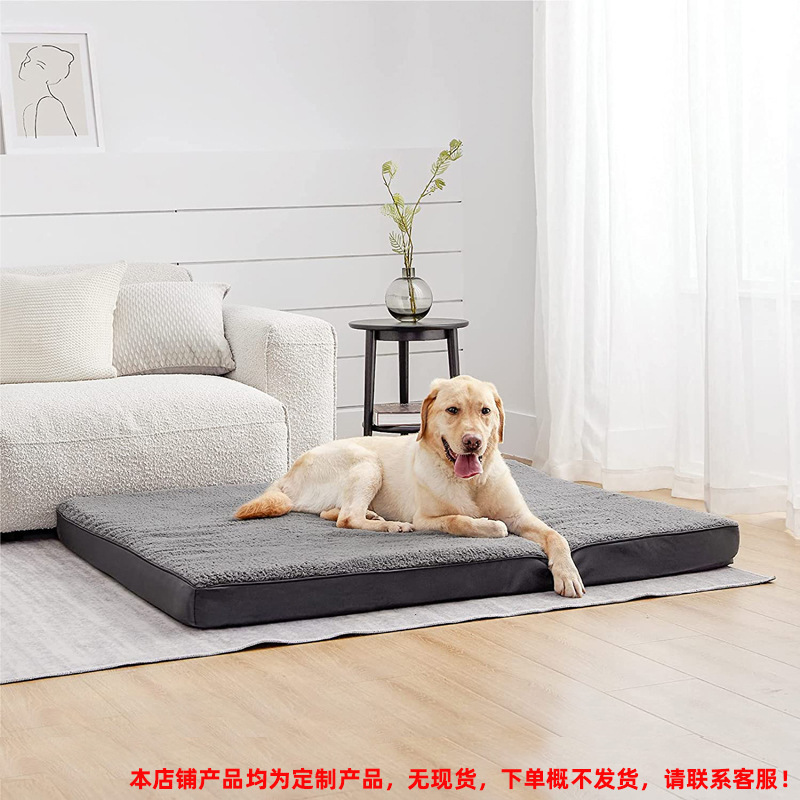
The cover is the first thing a large breed destroys. Dogs over 30 kg generate 3–5× the mechanical stress on cover fabrics compared to small breeds, through scratching, digging, and the sheer friction of 40+ kg shifting on the surface every night. Here is how cover fabrics compare:
| Cover Fabric | Denier Rating | Tear Strength | Water Resistance | Best For | Lifespan (Large Breed) |
|---|---|---|---|---|---|
| Cotton canvas | N/A (~300D equivalent) | Low | None | Small, gentle dogs only | 3–6 months |
| Polyester fleece | 150D–200D | Low–Medium | None | Indoor beds, cold climates | 6–12 months |
| 300D Oxford | 300D | Medium | Water-resistant | Medium dogs, light use | 12–18 months |
| 600D Oxford | 600D | High | Water-resistant (PU-coated) | Large breeds, general use | 2–3 years |
| 900D Oxford | 900D | Very high | Water-resistant | Large breeds, moderate chewers | 2.5–4 years |
| 1680D ballistic nylon | 1680D | Extreme | Waterproof (TPU backing) | Giant breeds, heavy chewers | 3–5 years |
Our recommendation for large breeds: 600D Oxford minimum. For Rottweilers, pit bulls, and other breeds with strong jaw pressure and digging instincts, go with 1680D ballistic nylon. The cost difference between 300D and 1680D is approximately $2–$4 FOB per bed, but the lifespan difference is 4–6×. That math works for both end consumers and wholesale buyers. For more on chew-resistant construction, see our chew-proof dog bed guide.
Weight Limits: How to Read Them (and Why Most Are Misleading)
Weight limits on dog beds fall into two categories: structural weight limit (how much weight the frame or base can physically hold without breaking) and functional weight limit (how much weight the bed can support while still providing adequate comfort and orthopedic benefit).
Most manufacturers only advertise the structural limit. A bed might say “rated for 45 kg” — meaning it won’t collapse — but the foam inside might be 30D, which will flatten to a pancake under a 45 kg Rottweiler within 3 months. The bed “holds” the weight; it just stops providing support.
What to look for:
- Elevated beds: Steel frames with cross-bar reinforcement typically have a structural limit of 50–75 kg. Aluminum frames cap at 30–50 kg. Always select a bed rated for at least 1.5× your dog’s body weight to account for impact when the dog jumps on.
- Memory foam beds: No structural frame to break, but foam density determines functional capacity. 40D foam functionally supports up to 60 kg; 50D foam up to 90 kg. Above those thresholds, the foam compresses past its recovery point and develops permanent indentations.
- Bolster beds: The bolster walls need independent support — often a rolled foam insert or PE board stiffener. Large breeds that lean on bolsters (Boxers, Bulldogs, Labs) will crush weak bolster fill within weeks. Look for PP board or high-density foam bolster cores.
At our factory, we test every bed design to 2× its rated capacity for 72 continuous hours before approving production. This ensures the bed performs reliably at its stated weight limit even under the dynamic forces of a dog jumping on and off repeatedly.
Best Bed Types by Large Breed Category
Not all large breeds have the same needs. Here is how we categorize them in our product development:
Joint-Sensitive Breeds (GSD, Golden, Lab, Rottweiler)
These breeds have genetic predisposition to hip dysplasia, elbow dysplasia, and arthritis. The American Kennel Club reports that over 19% of German Shepherds and 20% of Golden Retrievers develop hip dysplasia. For these dogs, an orthopedic memory foam bed is not a luxury — it is preventive medicine.
- Foam spec: 40D–45D solid-sheet memory foam, 10–12 cm thick
- Cover: 600D Oxford minimum, removable and machine-washable (these breeds shed heavily)
- Base: Non-slip silicone dots or anti-skid fabric to prevent the bed from sliding on hard floors when the dog gets up
- Shape: Rectangular or bolster — these breeds commonly sleep on their sides in a stretched position
Giant Breeds (Great Dane, Mastiff, Saint Bernard)
Giants pose the ultimate challenge: extreme weight (50–90+ kg), long body length requiring XXL dimensions, and many are heavy droolers that soak through standard covers. These dogs also have shorter lifespans (6–8 years) with early onset of joint issues, making proper bedding support even more critical.
- Foam spec: 50D memory foam, 12–15 cm thick, preferably with a 3–5 cm egg-crate base layer for airflow
- Cover: 1680D ballistic nylon with TPU waterproof backing (for drool protection)
- Size: Minimum 130 × 100 cm interior. Many giant breed owners opt for our Giant Human Dog Bed (200 cm) because standard pet beds simply are not large enough.
- Weight rating: 90 kg minimum structural capacity
Double-Coated / Overheating-Prone Breeds (Husky, Malamute, Bernese)
These breeds carry thick double coats that trap heat. In warmer climates (or heated homes in winter), they overheat on standard memory foam beds because foam retains body heat. Two solutions work:
- Option A — Elevated cot bed: Steel frame with Textilene mesh, providing 10–15 cm of airflow underneath. Our Waterproof Outdoor Dog Bed uses this design. Surface runs 3–5°C cooler than foam beds.
- Option B — Cooling gel memory foam: Standard 40D–45D foam with a 2–3 cm cooling gel top layer that absorbs and dissipates body heat. Effective for 2–4 hours before reaching thermal equilibrium.
Strong Chewers (Rottweiler, pit bull types, young large breeds)
Destructive chewing is the #1 reason dog beds get returned or replaced. For confirmed chewers, you need a purpose-built chew-resistant dog bed with these specs:
- Cover: 1680D ballistic nylon, double-stitched seams with hidden zippers
- Fill: Solid foam block (not shredded — chewers will pull out loose fill through any small tear)
- Zipper: YKK or equivalent heavy-duty, covered by a fabric flap so the dog cannot access it
- Edges: Reinforced binding tape on all perimeter seams (this is where most chew damage starts)
How to Measure Your Large Breed Dog for a Bed
The precise way to size a bed:
- Measure nose to tail base while the dog is standing relaxed (not tail tip — tail base where it connects to the body). Add 15 cm. This is your minimum bed length.
- Measure the dog lying on its side from paws to spine. Add 10 cm. This is your minimum bed width.
- Weigh your dog. Select foam density and bed weight rating based on the weight tables above.
- Observe sleeping position:
- Side sleeper (stretched out): Needs the most space. Size up one category.
- Curler (tucked in a ball): Can use standard size for breed. Donut or bolster beds work well.
- Sprawler (belly down, legs extended): Needs maximum length and width. Consider a flat mattress without bolsters.
For more detailed sizing across all breed sizes (not just large breeds), see our comprehensive dog bed size guide by breed.
Material Comparison: Memory Foam vs Fiber Fill vs Elevated Mesh for Large Dogs
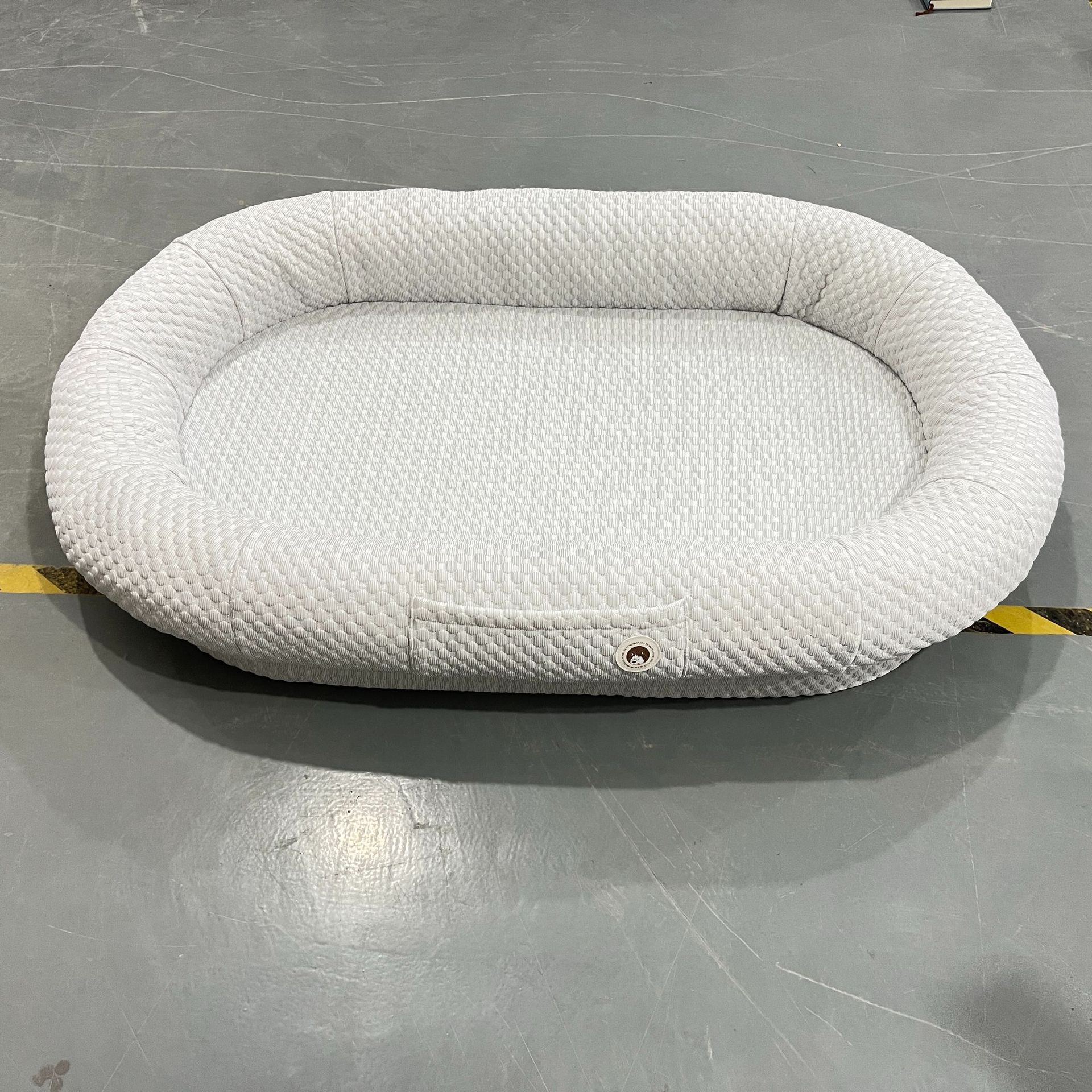
| Feature | Memory Foam (40D–50D) | PP Cotton / Fiber Fill | Elevated Mesh (Textilene) |
|---|---|---|---|
| Joint Support | Excellent — conforms to body shape, distributes pressure | Poor — compresses flat, creates pressure points | Good — even suspension, but no contouring |
| Durability (35+ kg dog) | 3–5 years | 3–6 months | 4–6 years (mesh replaceable) |
| Temperature | Warm (retains body heat) | Neutral | Cool (5–10 cm airflow gap) |
| Washability | Cover only (foam cannot be machine washed) | Full bed washable (but fill clumps) | Hose off, dries in minutes |
| Weight Capacity | Up to 90 kg (50D foam) | No structural limit, but support fails fast | 50–75 kg (steel frame) |
| Cost (FOB, XL size) | $12–$22 | $3–$8 | $8–$16 |
| Best Use Case | Senior dogs, joint issues, overnight sleeping | Temporary/guest beds, puppies (outgrow quickly) | Warm climates, outdoor use, daytime lounging |
For a detailed breakdown of elevated vs floor bed types, including frame material specs and mesh options, read our elevated dog bed vs floor dog bed comparison.
Common Mistakes When Buying Large Breed Dog Beds
After manufacturing dog beds for years and hearing feedback from hundreds of wholesale buyers and end consumers, these are the five most costly mistakes:
- Buying by breed name, not by measurements. A “German Shepherd bed” from different brands can vary by 20 cm in each dimension. Always check interior measurements against your dog’s actual body length and width.
- Ignoring foam density. “Memory foam” on a product listing means nothing without a density spec. 25D memory foam and 50D memory foam are completely different products. If the listing does not state density, it is almost certainly 25D–30D (the cheapest option).
- Choosing a removable cover without checking denier. A “removable, washable cover” in 150D polyester will last 3 months under a Lab. The zipper or seam will be the first point of failure.
- Skipping waterproof layers for drooling breeds. Mastiffs, Saint Bernards, Newfoundlands, and Bloodhounds produce enough drool to soak through standard covers into the foam core. Once foam absorbs moisture, it develops odor and mold that cannot be removed. A TPU waterproof liner between cover and foam is mandatory for these breeds.
- Using human bed pillows as dog beds. Human pillows use 20D–25D foam designed for 3–5 kg head weight, not 30–90 kg full body weight. They flatten immediately and provide zero orthopedic value for a large dog.
Wholesale and OEM: What to Specify When Ordering Large Breed Beds
If you are a retailer, distributor, or brand owner ordering XL and XXL dog beds from a manufacturer, here is the specification checklist that ensures you get a quality product:
- Foam: Solid-sheet memory foam, specify density (40D minimum for L, 45D–50D for XL/XXL)
- Foam thickness: 10 cm minimum for L, 12–15 cm for XXL
- Cover fabric: Specify denier (600D minimum), request a fabric swatch before bulk order
- Waterproof liner: TPU inner lining between foam and outer cover (essential for drooling breeds)
- Zipper: YKK or equivalent, covered by fabric flap
- Anti-slip base: Silicone dots or anti-skid PVC
- Stitching: Double-stitched perimeter seams, bar-tacked at stress points
- Compression packing: Specify roll-packed or vacuum-compressed for shipping efficiency (reduces volume by 60–70%)
At Feitu Pet, our minimum order quantity is 500 pcs per SKU for standard sizes and fabrics. Custom sizes, colors, and branding (logo printing, custom labels, hang tags) are available at the same MOQ. Request a quote with your specifications.
For a complete guide to evaluating pet bed manufacturers, including quality checkpoints and factory audit tips, read our 8 quality checkpoints for choosing a pet bed manufacturer.