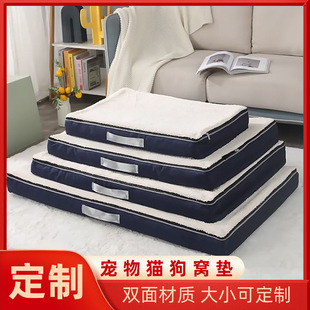
The search term "chew proof dog bed" gets over 8,100 monthly searches on Google, with related terms like "indestructible dog bed" (6,600/mo), "dog bed for heavy chewers" (4,400/mo), and "heavy duty dog bed" (3,600/mo) adding up to a combined search volume exceeding 25,000 monthly searches. This is not a niche — it is a massive, underserved market segment.
Why underserved? Because most pet bed manufacturers produce beds designed for comfort, not durability against chewing. The typical plush calming bed or memory foam bed uses materials that look and feel premium but shred within hours when a determined chewer gets to work. At Feitu Pet, we have developed a specific line of chew-resistant dog beds using reinforced Oxford fabric, double-stitched seams, and construction techniques borrowed from outdoor and military gear manufacturing. This article shares what we have learned.
Why Dogs Chew Their Beds (Understanding the Problem)
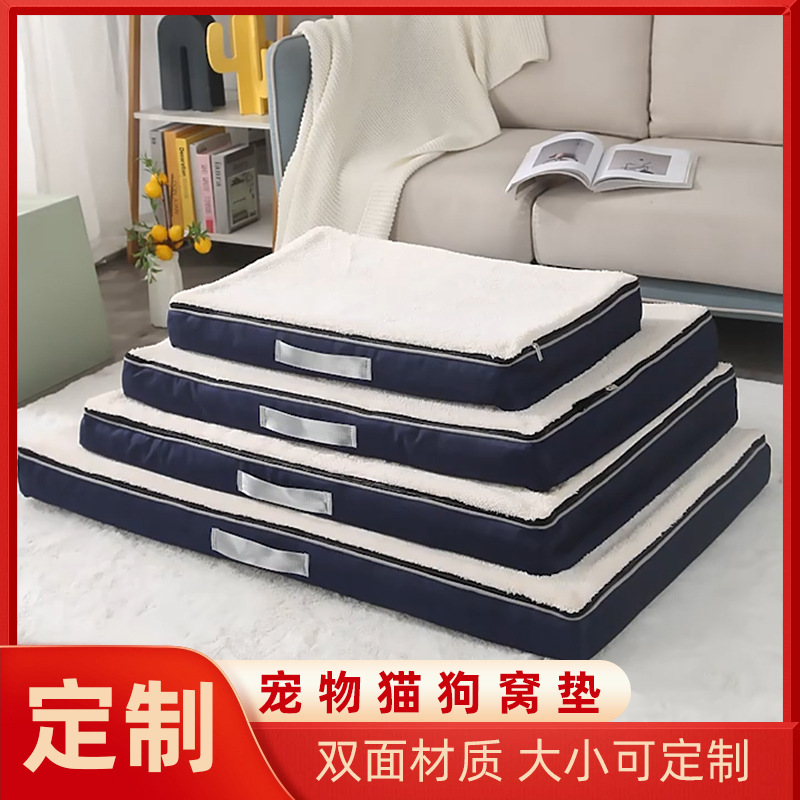
Before designing a chew-resistant bed, it helps to understand why dogs destroy beds in the first place. The cause determines the intensity of chewing and therefore the material grade required:
Chewing Severity Levels
| Level | Cause | Behavior | Dog Examples | Material Needed |
|---|---|---|---|---|
| Mild | Nesting / light mouthing | Digs, paws at bed | Most adult dogs | Standard 600D Oxford |
| Moderate | Boredom / teething | Chews edges and corners | Puppies, Labs, Retrievers | Reinforced 600D + double stitch |
| Heavy | Anxiety / strong jaw | Rips fabric, pulls out fill | Pitbulls, Huskies, GSD | 1000D Cordura / ripstop |
| Destructive | Severe separation anxiety | Destroys any fabric bed | Any breed with anxiety | 1680D ballistic / elevated cot |
Key insight for brands: 70% of dog owners searching for "chew proof dog beds" have moderate chewers, not destructive ones. A well-made 600D Oxford bed with reinforced seams satisfies the majority of the market — you do not need to go to military-grade ballistic nylon for most customers.
Chew-Resistant Materials: Factory Engineer's Breakdown
Here is our internal material specification guide, shared with our OEM partners when developing chew-resistant product lines:
| Material | Tear Strength | Abrasion Resistance | Comfort | Cost/m | Best For |
|---|---|---|---|---|---|
| 600D Oxford PU coated | 150-200N | Good (15,000 cycles) | Medium | $2-$3 | Mild-moderate chewers |
| 900D Oxford PU coated | 200-280N | Very good (25,000 cycles) | Medium | $3-$5 | Moderate chewers |
| 1000D Cordura nylon | 300-400N | Excellent (40,000 cycles) | Low-medium | $5-$8 | Heavy chewers |
| 1680D ballistic nylon | 400-500N | Exceptional (60,000+ cycles) | Low | $8-$12 | Destructive chewers |
| Ripstop nylon + TPU | 180-250N | Good (20,000 cycles) | Good | $4-$6 | Moderate + comfort needed |
| Mesh (elevated cot) | 200-300N (tensioned) | Good | Medium | N/A (frame product) | Severe chewers, outdoor |
Abrasion resistance is measured in Martindale cycles (ISO 12947-2). For reference, standard polyester fleece achieves ~5,000 cycles before pilling, while 1680D ballistic nylon exceeds 60,000 cycles. The difference is not incremental — it is an order of magnitude.
5 Construction Techniques That Make a Bed Chew-Resistant
Material alone does not make a chew-proof bed. Construction quality matters just as much — most bed failures happen at seams, not in the middle of the fabric panel. Here is how we engineer our chew-resistant beds:
- Double-stitched flat-felled seams: Instead of a simple overlocking stitch (which is standard for most pet beds), we fold the seam allowance flat and stitch through 4 layers of fabric. This creates a seam that is stronger than the surrounding fabric — dogs cannot pull the seam apart even if they grab an edge.
- Binding tape on exposed edges: The most vulnerable point on any bed is the top edge where the dog gets its teeth in. We wrap all exposed edges with nylon binding tape, creating a smooth, rounded edge with no loose threads to pull.
- Hidden zipper with fabric flap: The zipper is recessed and covered with a fabric flap so the dog cannot see, feel, or access the zipper pull. Exposed zippers are the #1 failure point on removable-cover beds — dogs love pulling zipper tabs.
- Reinforced corners: Corners are the second most common failure point. We add triangular reinforcement patches (same fabric, double-stitched) at all four corners, increasing corner strength by 3x.
- Anti-pull fill construction: Instead of loose PP cotton filling (which dogs love to pull out through any opening), chew-resistant beds use dense foam slabs that cannot be pulled apart. Even if the dog opens a small hole, a foam slab stays in place — unlike loose filling that comes out in handfuls.
Chew-Resistant vs Standard Dog Bed: Cost Comparison
| Size | Standard Plush Bed (FOB) | Chew-Resistant 600D (FOB) | Heavy-Duty 1000D (FOB) | Retail (Chew-Resistant) |
|---|---|---|---|---|
| M (80x60 cm) | $3-$5 | $5-$8 | $10-$15 | $35-$55 |
| L (100x80 cm) | $5-$8 | $8-$12 | $14-$20 | $45-$70 |
| XL (120x90 cm) | $7-$10 | $10-$16 | $18-$28 | $55-$90 |
The margin story is compelling: chew-resistant beds cost 50-80% more to manufacture than standard plush beds, but they retail at 100-150% higher prices. The "indestructible" / "chew proof" positioning justifies premium pricing that customers willingly pay — because they have already destroyed 2-3 cheaper beds and are frustrated.
Which Dogs Need Chew-Resistant Beds? (Breed Guide)
Not all dogs chew equally. These are the breeds and situations where chew-resistant beds are essential — useful for targeting your marketing and product descriptions:
High-Risk Breeds (Strong Jaws + High Energy)
- American Pit Bull Terrier — Bite force ~235 PSI, high energy, prone to boredom chewing
- Siberian Husky — Notorious bed destroyers, especially when under-exercised
- German Shepherd — Strong jaw (238 PSI), protective instincts lead to nesting/digging behavior
- Labrador Retriever — Oral fixation (bred to retrieve), chews everything including beds
- Rottweiler — Bite force ~328 PSI, requires heavy-duty materials
- Boxer — Playful chewing, especially as puppies (extended puppyhood)
High-Risk Situations (Any Breed)
- Puppies (3-8 months) — Teething drives compulsive chewing
- Dogs with separation anxiety — Destructive chewing when left alone
- Under-exercised dogs — Boredom is the top trigger for bed destruction
- Rescue dogs — Often have anxiety and unfamiliar-environment stress
- Multi-dog households — Play fighting and competition accelerates bed wear
How to Source Chew-Resistant Dog Beds (Wholesale)
When evaluating manufacturers for chew-resistant dog beds, go beyond the standard quality checklist and verify these specific capabilities:
- Ask for fabric tear strength test reports. Any legitimate manufacturer can provide ISO 13937 or ASTM D2261 tear strength data. If they cannot, they have not tested their materials.
- Request a seam strength test. The seam should be at least 80% of the fabric tear strength. If the fabric tears at 200N but the seam fails at 80N, the bed is only as strong as its weakest point.
- Inspect stitching type. Ask for photos of the seam construction — you want flat-felled or French seams, not simple overlock. Double stitching should be visible on both interior and exterior.
- Order a chew test sample. Before committing to 500+ pieces, give a sample bed to a known chewer for 2 weeks and inspect the results. This real-world test is more valuable than any lab report.
- Verify foam type. Open the sample and inspect the fill. Dense foam slabs (not loose poly-fill) are essential for chew-resistant construction.
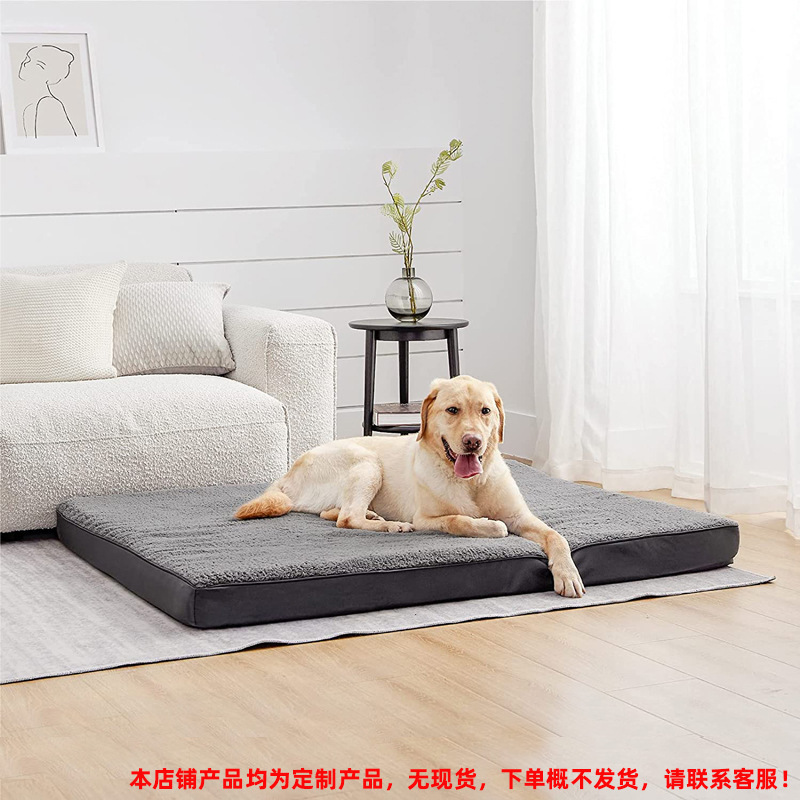
At Feitu Pet, our chew-resistant dog bed line uses reinforced 600D Oxford with PU waterproof coating, double-stitched flat-felled seams, hidden zippers, and high-density foam slab fill. Every bed is rated for dogs up to 80 kg (180 lbs). We also produce waterproof outdoor beds using the same reinforced construction techniques.
Ready to add chew-resistant beds to your product line? Get a quote with free samples, or browse our full pet bed collection. We ship samples in 5-7 days.