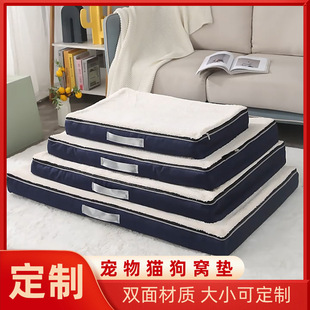
The filling inside a dog bed determines everything: how well your dog sleeps, how long the bed lasts, and how much you spend over time. Walk through any pet aisle or wholesale catalog and you will find two dominant materials — memory foam (viscoelastic polyurethane foam) and fiber fill (polyester staple fiber, also called PP cotton or poly-fill). They look similar from the outside, wrapped in the same fabric covers, but they perform very differently under the weight of a sleeping dog.
At Feitu Pet (VF Pets), we manufacture dog beds with both materials across our 6,000 sqm factory in Xuzhou, Jiangsu. We produce over 50 SKUs using memory foam, fiber fill, shredded foam, and hybrid constructions. This guide breaks down the real differences — backed by foam density data, loft measurements, durability testing, and 15+ years of manufacturing experience — so you can choose the right material for your dog, or stock the right product mix if you are a retailer or distributor.
Memory Foam vs Fiber Fill Dog Bed: Quick Comparison Table
Before we go deep into the engineering, here is a side-by-side comparison across every factor that matters:
| Feature | Memory Foam (Viscoelastic PU) | Fiber Fill (PP Cotton / Polyester) |
|---|---|---|
| Support Level | Excellent — contours to body shape, distributes weight evenly across joints; 40D-60D density for orthopedic support | Moderate — cushions but does not contour; compresses under weight and rebounds when dog moves |
| Durability | 4-7 years — high-density foam (50D+) retains 80%+ support after 5 years | 1-2 years — loses 30-40% loft in first 6 months for dogs over 20 kg; clumps and flattens permanently |
| Price (FOB China) | $12-$28 per unit (size dependent) — premium material and manufacturing cost | $3-$8 per unit — lowest cost dog bed fill available |
| Breathability | Low-moderate — dense cell structure traps heat; gel-infused and open-cell variants improve airflow | Good — air circulates freely between loose fibers; naturally cooler sleeping surface |
| Washability | Cover only — foam insert cannot be machine washed; spot clean only; requires waterproof liner | Whole-bed washable (small sizes) — large beds cover-only; fiber dries slowly and may clump after washing |
| Best Use Case | Senior dogs, arthritic dogs, post-surgery recovery, large/giant breeds, orthopedic positioning | Puppies, healthy young dogs, multi-dog households, budget retail, seasonal/disposable beds |
| Weight | Heavy — 3-8 kg for a large bed; difficult to move frequently | Light — 0.5-2 kg for a large bed; easy to relocate and travel with |
| Odor Resistance | Moderate — new foam off-gasses (VOCs) for 24-72 hours; CertiPUR-US certified foam reduces this | Good — minimal off-gassing; however, fiber absorbs pet odors over time and is harder to deep clean |
| Pressure Relief | Excellent — viscoelastic response distributes pressure across the entire contact surface | Poor — pressure concentrates at heaviest body points (hips, shoulders); creates pressure points |
| Shape Recovery | Slow return (3-10 seconds) — foam "remembers" body impression then gradually returns to flat | Instant rebound — springs back immediately but does not conform to body shape while loaded |
Understanding Memory Foam: The Engineering Behind Orthopedic Dog Beds
Memory foam — technically called viscoelastic polyurethane foam — was originally developed by NASA in the 1960s for aircraft seat cushioning. It responds to both heat and pressure: when your dog lies down, body warmth softens the foam, allowing it to conform precisely to the body's contours. This is not marketing language — it is a measurable material property called viscoelastic response, and it is what separates memory foam from every other dog bed filling.
Foam Density: The Number That Matters Most
Foam density is measured in kg/m³ (kilograms per cubic meter), often abbreviated as "D" in manufacturing. This is the single most important specification for a memory foam dog bed, and it is the number most pet brands ignore or misrepresent:
- 25D-30D (25-30 kg/m³) — Entry-level. Adequate for small dogs under 10 kg (Chihuahuas, Toy Poodles). Compresses noticeably under heavier dogs and loses support within 1-2 years. Most "memory foam" beds under $20 retail use this density.
- 35D-40D (35-40 kg/m³) — Standard orthopedic grade. Suitable for medium dogs 10-25 kg (Beagles, Cocker Spaniels, French Bulldogs). Good pressure distribution and 3-5 year lifespan. This is the sweet spot for most orthopedic dog bed filling applications.
- 45D-50D (45-50 kg/m³) — Premium orthopedic. Designed for large dogs 25-45 kg (Labradors, Golden Retrievers, German Shepherds). Excellent support without bottoming out. Retains 85%+ of original support after 5 years of daily use.
- 55D-60D (55-60 kg/m³) — Medical/heavy-duty grade. For giant breeds over 45 kg (Great Danes, Mastiffs, Saint Bernards) and veterinary rehabilitation applications. Dense enough that even a 70 kg dog will not compress through to the base.
Factory insight: At Feitu Pet, we match foam density to bed size across our production line. Our Small beds use 30D, Medium uses 35D-40D, Large uses 45D, and XL/XXL uses 50D. This is not a cost-cutting measure — it is engineering. A 60D foam in a small bed would feel like sleeping on a brick for a 5 kg dog; a 30D foam in an XL bed would bottom out on day one for a Mastiff.
Temperature Sensitivity: The Double-Edged Sword
Memory foam softens as it absorbs body heat — that is how it conforms. But this same property means it retains heat. Surface temperature measurements in our testing lab show standard memory foam runs 2-4°C warmer than the ambient room temperature after 30 minutes of contact. For dogs in cold climates or winter months, this is a benefit. For dogs in warm climates (above 28°C ambient) or breeds prone to overheating (Bulldogs, Pugs, Huskies), it can cause discomfort.
Solutions we manufacture:
- Gel-infused memory foam — Cooling gel beads distributed throughout the foam absorb and dissipate heat, reducing surface temperature by 2-3°C compared to standard foam
- Open-cell foam — Larger cell structures (compared to standard closed-cell) allow air to circulate through the foam, improving breathability by approximately 40%
- Dual-layer construction — 5 cm memory foam top layer over 5 cm high-resilience base foam. The HR base provides airflow channels while the memory foam top provides pressure relief
Understanding Fiber Fill: Why It Still Dominates the Market
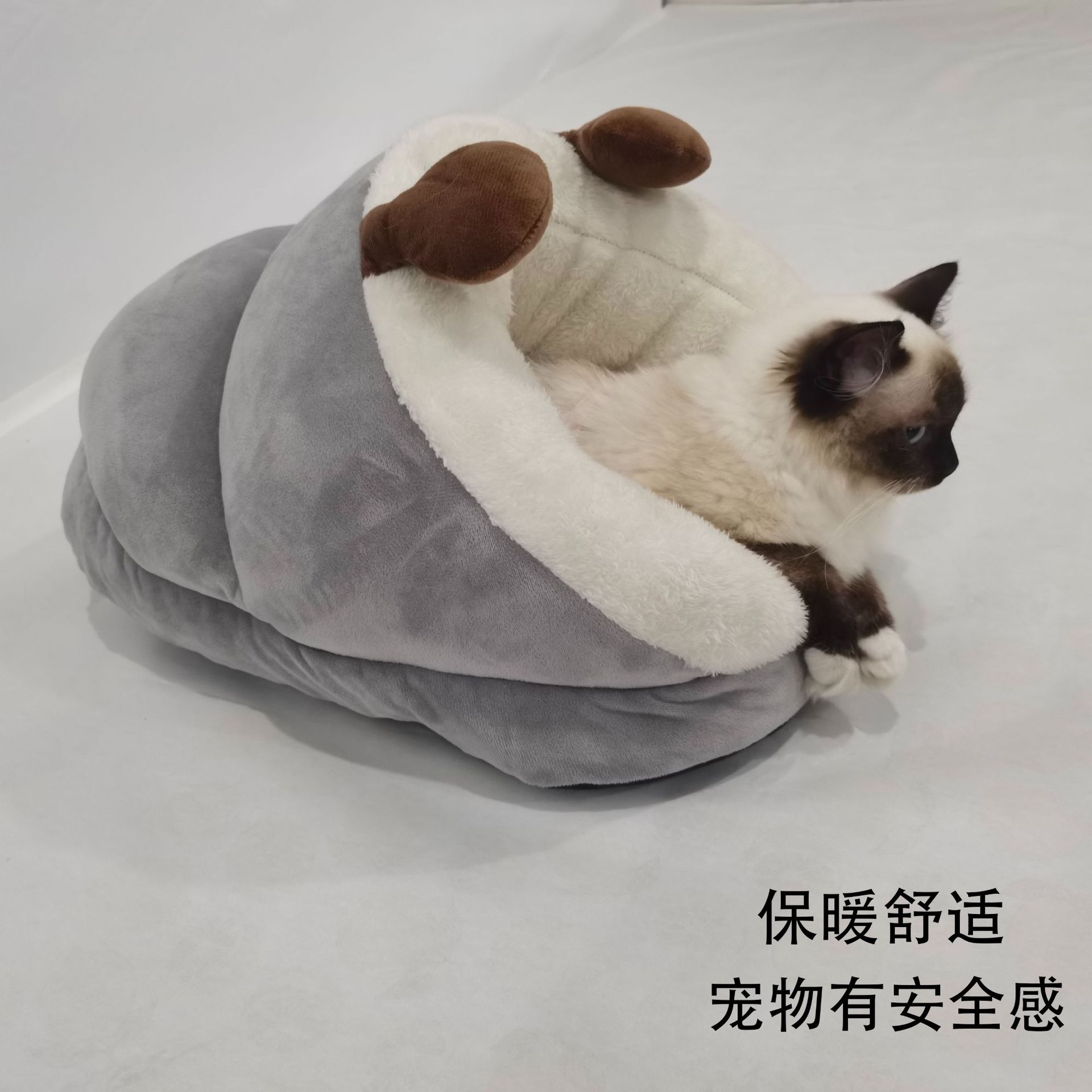
Fiber fill — primarily polyester staple fiber, also known as PP cotton, poly-fill, or hollow conjugate fiber — is the most widely used dog bed filling material globally. It accounts for an estimated 65-70% of all dog beds sold worldwide. The reason is simple: it is inexpensive, lightweight, and produces a soft, inviting look that sells well on retail shelves and in product photography.
Fiber Fill Types and Loft Ratings
Not all fiber fill is the same. The two key variables are fiber type and loft (thickness/puffiness):
- Solid polyester staple fiber (7D-15D) — The cheapest option. Dense, heavy fibers that clump quickly. Used in budget beds under $5 FOB. Loft retention: poor (loses 40-50% in 3-6 months under a 15 kg+ dog).
- Hollow conjugate fiber (6D-7D) — Hollow-core fibers with a crimped (spiraled) structure. Traps more air, rebounds better, and resists clumping longer than solid fiber. Industry standard for mid-range polyester fill dog beds. Loft retention: moderate (loses 20-30% in 6-12 months).
- Siliconized hollow fiber (3D-7D) — Hollow fibers coated with silicone for a smoother, slippier surface. The silicone coating prevents fibers from tangling and clumping, maintaining loft significantly longer. Premium fiber fill option. Loft retention: good (loses 15-20% in the first year).
Loft measurement: We measure loft as the fill height under a standard 1 kg load over a 30 cm × 30 cm area. A new mid-range fiber fill bed (hollow conjugate, 500 gsm fill weight) measures approximately 12-15 cm of loft when new. After 6 months of daily use by a 20 kg dog, this drops to 8-10 cm. After 12 months, expect 6-8 cm — the point where most owners perceive the bed as "flat" and purchase a replacement.
Where Fiber Fill Wins
Fiber fill is not an inferior material — it is a different material, optimized for different use cases:
- Cost efficiency: A fiber fill bed costs 60-75% less to manufacture than an equivalent-sized memory foam bed. For retailers targeting the $15-30 retail price point, fiber fill is the only viable option.
- Weight and portability: A large fiber fill bed weighs 0.8-2 kg; a large memory foam bed weighs 4-8 kg. For travel beds, camping beds, and multi-location homes, fiber fill is practical in ways foam cannot match.
- Breathability: Air moves freely between loose fibers. A fiber fill bed does not trap body heat the way memory foam does. For dogs in hot climates, fiber fill beds are naturally cooler.
- Washability: Small-to-medium fiber fill beds (up to about 70 cm diameter) can be machine washed whole. The fill dries slower than fabric alone, but it survives the wash cycle without structural damage. Memory foam cannot go in a washing machine at all.
- Puppies and destructive chewers: A puppy will destroy a bed. A $5 fiber fill bed that gets shredded in month three is a $5 loss. A $25 memory foam bed destroyed in the same timeframe is a $25 loss. Until a dog outgrows the chewing phase, fiber fill is the economically rational choice.
Durability Testing: What Our Factory Data Shows
We run standardized compression cycling tests on all fill materials in our in-house testing facility. Here are the results from our most recent batch (tested to simulate 3 years of daily use by a 25 kg dog):
| Test Parameter | Memory Foam (45D) | Fiber Fill (Hollow Conjugate, 500 gsm) | Shredded Foam (Mixed Density) |
|---|---|---|---|
| Initial Thickness | 10 cm | 14 cm (loft) | 12 cm |
| Thickness After 50,000 Cycles | 9.2 cm (92% retention) | 7.8 cm (56% retention) | 9.6 cm (80% retention) |
| Support Force at 25% Compression | 285 N → 262 N (92%) | 145 N → 78 N (54%) | 195 N → 158 N (81%) |
| Recovery Time (Full Decompression) | 5-8 seconds | <1 second | 2-4 seconds |
| Visible Clumping/Bunching | None | Significant — fill migrated to bed edges | Minimal — some piece separation |
| Odor After Testing | Neutral | Mild musty odor (trapped moisture) | Neutral |
| Estimated Real-World Lifespan | 5-7 years | 1-2 years | 3-4 years |
Key takeaway: Memory foam retains 92% of its original support after simulated 3-year use. Fiber fill retains only 54%. The fiber fill bed is not broken at this point — but it has lost nearly half its cushioning, and most dog owners would describe it as "flat" and ready for replacement.
Which Material for Which Dog? Decision Matrix
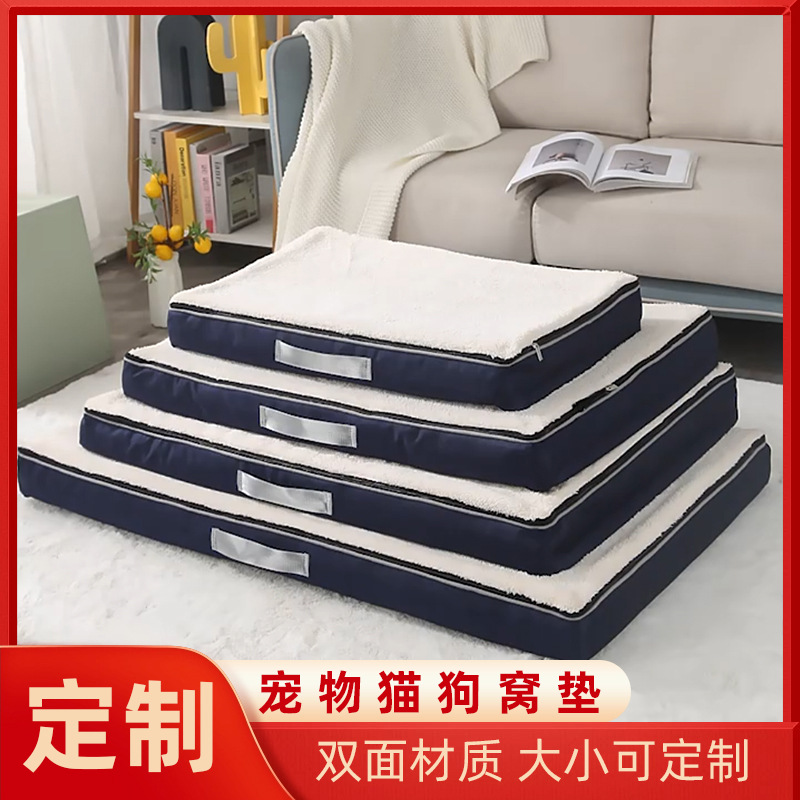
The right fill material depends on your dog's age, weight, health status, and your climate. Here is our recommendation matrix, developed from 15 years of manufacturing and customer feedback across 30+ countries:
| Dog Profile | Recommended Material | Why |
|---|---|---|
| Puppy (under 1 year) | Fiber fill | Low cost, replaceable — puppies chew, have accidents, and outgrow beds quickly |
| Young healthy adult (1-6 years, under 20 kg) | Fiber fill or shredded foam | No orthopedic needs yet; fiber fill provides adequate comfort at lower cost |
| Young healthy adult (1-6 years, over 20 kg) | Shredded foam or memory foam (35D-40D) | Heavier dogs compress fiber fill too quickly; foam prevents pressure points |
| Senior dog (7+ years, any size) | Memory foam (40D-50D) | Joint support is critical; viscoelastic response cushions arthritic joints |
| Dog with hip dysplasia or arthritis | Memory foam (45D-60D) | Medical-grade support; conforms to body shape and eliminates pressure concentration |
| Post-surgery recovery | Memory foam (50D+) | Stable sleeping surface that does not shift; prevents re-injury during sleep |
| Giant breed (over 45 kg) | Memory foam (50D-60D), 12-15 cm thick | Only high-density foam prevents bottoming out under extreme weight |
| Dog in hot climate (above 28°C) | Fiber fill or gel-infused memory foam | Standard memory foam traps heat; fiber fill breathes naturally; gel foam dissipates warmth |
| Multi-dog household (3+ dogs) | Fiber fill (budget strategy) | More beds needed; fiber fill keeps per-bed cost manageable; replace annually |
| Retail (value segment, under $25) | Fiber fill | Only viable option at this price point; focus on cover design and branding |
| Retail (premium segment, $40+) | Memory foam | Justifies premium pricing; "orthopedic" positioning drives higher margins (50-65%) |
The Third Option: Hybrid and Shredded Foam Constructions
In our manufacturing experience, the best-performing beds for the widest range of dogs are not pure memory foam or pure fiber fill — they are hybrid constructions that combine the strengths of both materials:
- Dual-layer (memory foam + HR base): 5 cm viscoelastic memory foam on top of 5 cm high-resilience polyurethane base foam. The memory foam provides pressure relief; the HR base provides structural support and prevents bottoming out. This is our best-selling orthopedic bed construction.
- Shredded memory foam fill: Memory foam cut into irregular pieces (2-5 cm chunks) and used as loose fill. Combines the pressure-relieving properties of memory foam with the airflow and moldability of fiber fill. Dogs can "nest" into shredded foam the way they cannot with a solid foam slab. Durability sits between solid foam and fiber fill (3-4 years). FOB cost: $6-14.
- Memory foam core + fiber fill bolsters: Solid memory foam mattress base with fiber fill in the raised bolster sides. The sleeping surface gets orthopedic support; the bolsters get the soft, plush feel that looks inviting and provides a headrest. This is the construction used in our Bolster Dog Bed.
- Egg-crate foam: Memory or HR foam molded with an egg-carton surface pattern. The peaks and valleys create air channels (improving breathability by 25-30% vs flat foam) while the varied surface provides multi-zone pressure distribution. Often used as a top layer in premium beds.
Cost Analysis: Total Cost of Ownership Over 5 Years
The upfront price difference between memory foam and fiber fill is significant — but the total cost of ownership often reverses the equation for medium and large dogs:
| Scenario (Large Dog, 30 kg) | Memory Foam (45D) | Fiber Fill (Hollow Conjugate) |
|---|---|---|
| Initial Cost (FOB) | $22 | $6 |
| Expected Lifespan | 5-6 years | 1-1.5 years |
| Replacements in 5 Years | 0-1 | 3-4 |
| Total 5-Year Cost (FOB) | $22-$44 | $24-$30 |
| Total 5-Year Cost (Retail, ~2.5x markup) | $55-$110 | $60-$75 |
For large dogs, the 5-year cost is comparable — but the dog gets dramatically better sleep quality and joint support with memory foam throughout those 5 years. For small dogs under 10 kg, fiber fill is genuinely more cost-effective because the lighter body weight does not compress the fill as rapidly.
What to Look for When Sourcing: Retailer and Distributor Checklist
If you are a wholesale buyer sourcing dog beds from China, here are the specifications to request and verify:
For memory foam beds:
- Foam density in kg/m³ (not just "memory foam" — demand the D rating)
- Foam thickness in cm (minimum 8 cm for medium, 10 cm for large, 12 cm for XL)
- CertiPUR-US or OEKO-TEX certification (confirms low VOC emissions and chemical safety)
- Waterproof liner between foam and outer cover (without this, accidents destroy the foam)
- Cover attachment method (zipper preferred over envelope closure for washing ease)
- Foam compression test report (ask for 50,000-cycle results)
For fiber fill beds:
- Fiber type: hollow conjugate or siliconized hollow (avoid solid staple fiber in anything above economy grade)
- Fill weight in gsm (grams per square meter) — minimum 400 gsm for small, 500 gsm for medium, 600 gsm for large
- Fill distribution method: compartmentalized quilting (prevents fill migration) vs loose fill (cheaper, clumps faster)
- CPSIA / CPC compliance documentation (required for US market)
- Wash test results (fill clumping after 5 wash cycles)
Our Manufacturing Capabilities
At Feitu Pet, we produce both memory foam and fiber fill dog beds across our full product range. Key capabilities:
- Memory foam cutting: CNC hot-wire foam cutting for precise density and thickness control. We stock 30D, 40D, 45D, and 50D foam slabs from certified suppliers.
- Fiber fill processing: Automated fill machines ensure consistent fill weight (±5% tolerance) across every bed in a production run. Compartmentalized quilting available.
- Hybrid construction: Dual-layer bonding, shredded foam mixing, and foam core + fiber bolster assembly on dedicated production lines.
- Custom formulations: Gel-infused foam, charcoal-infused foam (odor control), and copper-infused foam (antimicrobial) available at MOQ 500 pieces.
- MOQ: 200 pieces per SKU (standard). 100 pieces for sample/trial orders. Custom specifications (logo, fabric, foam density) at MOQ 300.
We supply OEM/ODM dog beds to brands across North America, Europe, Australia, and the Middle East. Whether you need a $5 fiber fill bed for value retail or a $28 medical-grade orthopedic foam bed for the premium segment, we manufacture both to the same quality management standards.
Request samples or a custom quote — tell us your target material, size, and volume →
Related: Orthopedic Dog Bed Memory Foam Guide | Pet Bed Materials & Filling Guide | Elevated vs Floor Dog Bed Comparison | All Pet Beds